IT | EN
AWA AI Teams

A Team of AI Agents for every client business

Your client isn't buying a chatbot. They're buying a team: AI agents with roles, goals and a lead who reports to you. Inside AWA, ready in one click.

The Problem Today

An AI consultant today sells projects. Every client is a configuration built by hand: which models, which tools, which permissions, how much they can spend. Weeks of work that don't reuse, and a margin that thins out with every new client.

What Changes with AWA AI Teams

The consultant opens a client in AWA, presses a button, and finds a team of agents already built: structure, skills, tools, spending cap. From there their job is giving goals and checking results — not assembling infrastructure.

What the Consultant Gets

A team, not a tool

Agents with real roles and a chain of command. They receive goals, split the work, report back. The consultant stays the director.

Already optimized

Models, integrations and skills chosen and tested by us. No technical configuration, no choice to get wrong.

Under their brand

The platform carries their agency's logo and their client's. No third-party product in between.

AWA Integration

From an AWA client to an operating team

1

Create the AI Team

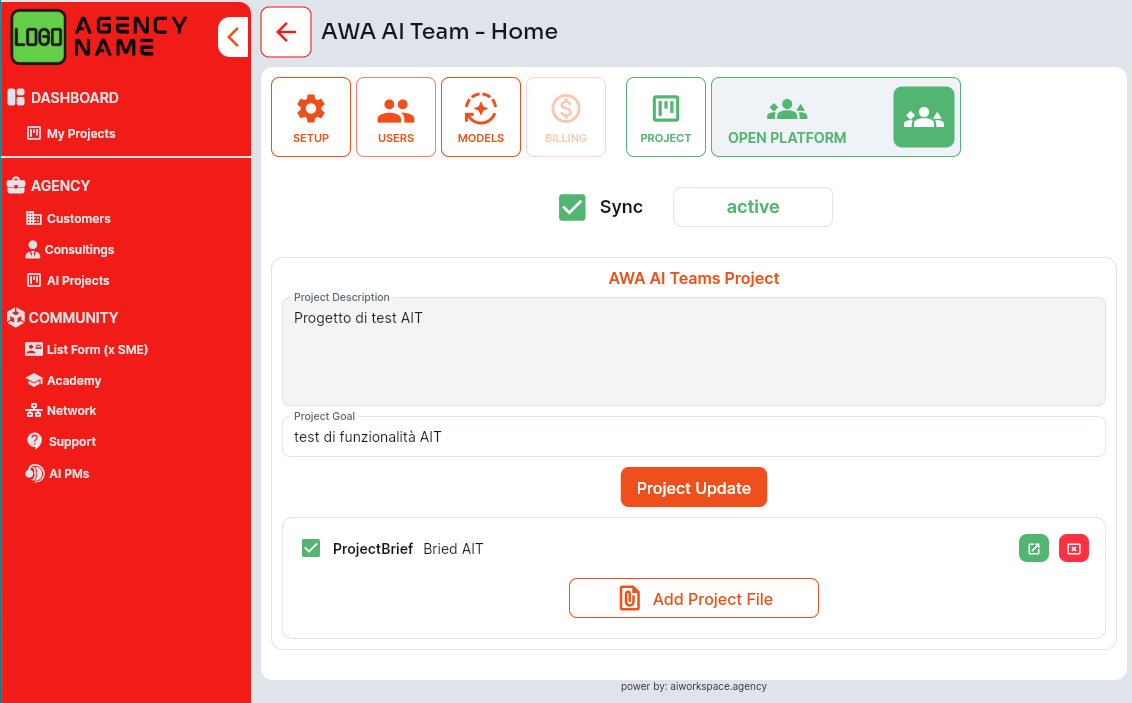
Inside the client, in AWA, one button. The environment is born complete: team, skills, tools, monthly budget.

2

Choose who has access

People are already in AWA. No invitation, no registration, no new password to remember.

3

Configure AI Adapters

Choose which AI providers to make available to the Team's AI Agents (detailed in the next section).

4

Sign in and work

One click and you're in, already authenticated, in the right client. You assign goals and watch the results come in.

AWA AI Team setup inside AWA

AI consumption is routed through AWA and measured per token. The consultant sees a clear cost per client, with a cap that stops spending before it crosses the threshold — not after.

Under the Hood

Models, budget and roles

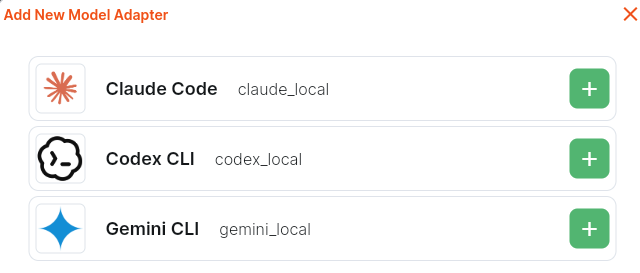
LLM model adapter configuration

3 configurable LLM adapters

The first models integrated are Claude Code (Anthropic), Codex CLI (OpenAI) and Gemini CLI (Google Cloud) — the agency chooses which adapter to configure for the team. The apiKey is entered once and never stored by AWA: it's transferred and registered in AIT securely, encrypted.

The "Customer Adapter" flag decides who pays for AI traffic: on, the AI provider account belongs to the client and AWA billing only charges the agency's markup; off, traffic runs through the client's AWA wallet with the markup included.

The "Agentic Loop" method

AWA AI Teams uses a method of working with LLMs that's different from classic prompting, with heavy input token usage (around 80% from cache). Cost per call runs higher than standard conversational use: model choice should be weighed accordingly, not just on price per token.

Budget and user roles

Every team has a configurable monthly budget, with automatic warnings and a hard stop as it approaches the threshold. Users synced from AWA access with a defined role: owner, admin, operator or viewer.

BETA Service

Request beta access

AWA AI Teams is currently activated only for consultants enabled by AWA. Sign up as an agency/consultant and request access.

A scalable rollout, not an instant switch-on

Bringing an AI Team up to speed for an SME typically takes 45-60 days and preliminary analysis work: an AI Team Brief and an AI Team Project (org chart, resources, and for each one a Condition of Satisfaction, instructions and skills).

An AI Team integrates into the client's organization and works alongside people: it should be rolled out gradually, often after a first test with Relevance AI, not switched on and left alone.


AWA AI TEAM
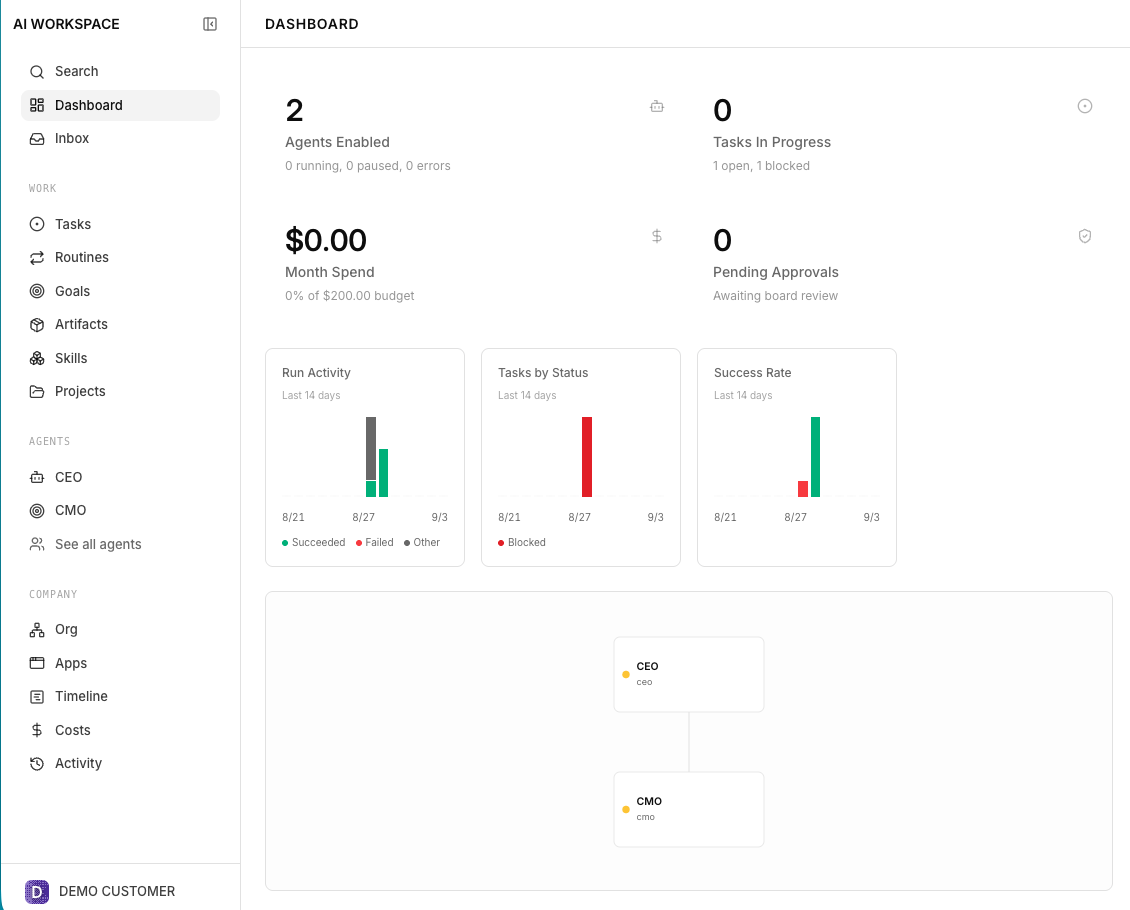
AWA AI Teams dashboard in production

Inside AWA AI Teams

AWA AI Teams inherits the open-source architecture of Paperclip AI — org chart, budgets, a full execution history — in a heavily customized adaptation: interface rebranded with the agency's and client's brand, exclusive components beyond the open-source version, governance managed centrally by AWA.

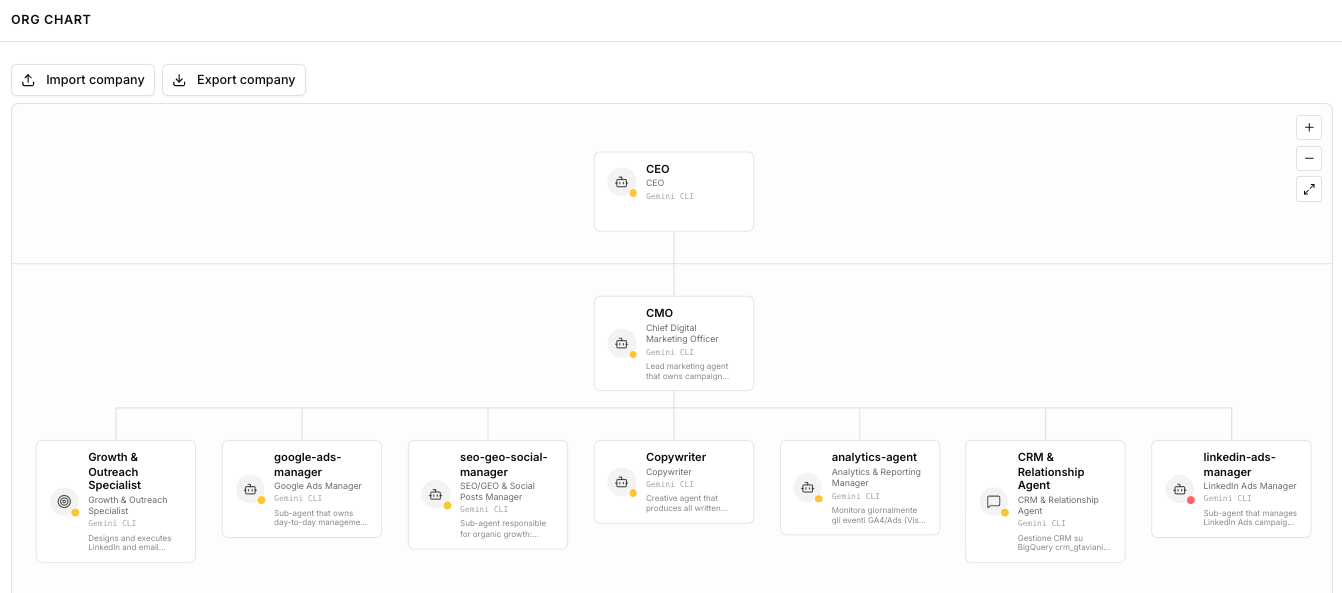
AWA AI Teams agent org chart

Org Chart: an org chart your agents actually work inside

Every agent has a manager, a role, and sub-agents reporting to it — not a flat list of bots. A CMO delegates to a Google Ads manager, an SEO/GEO specialist, a copywriter, an analytics agent: each one scoped to a job, not a prompt. It's ai agent org chart discipline, inherited from Paperclip AI's orchestration model and rebuilt for the AWA consultant to run without touching a line of config.

Projects: the project as an activity aggregator

Every Project in AWA AI Teams aggregates everything needed to move a goal forward:

  • Goal — with its Condition of Satisfaction (CoS)
  • Budget — dedicated to the project
  • Tasks — that make it up
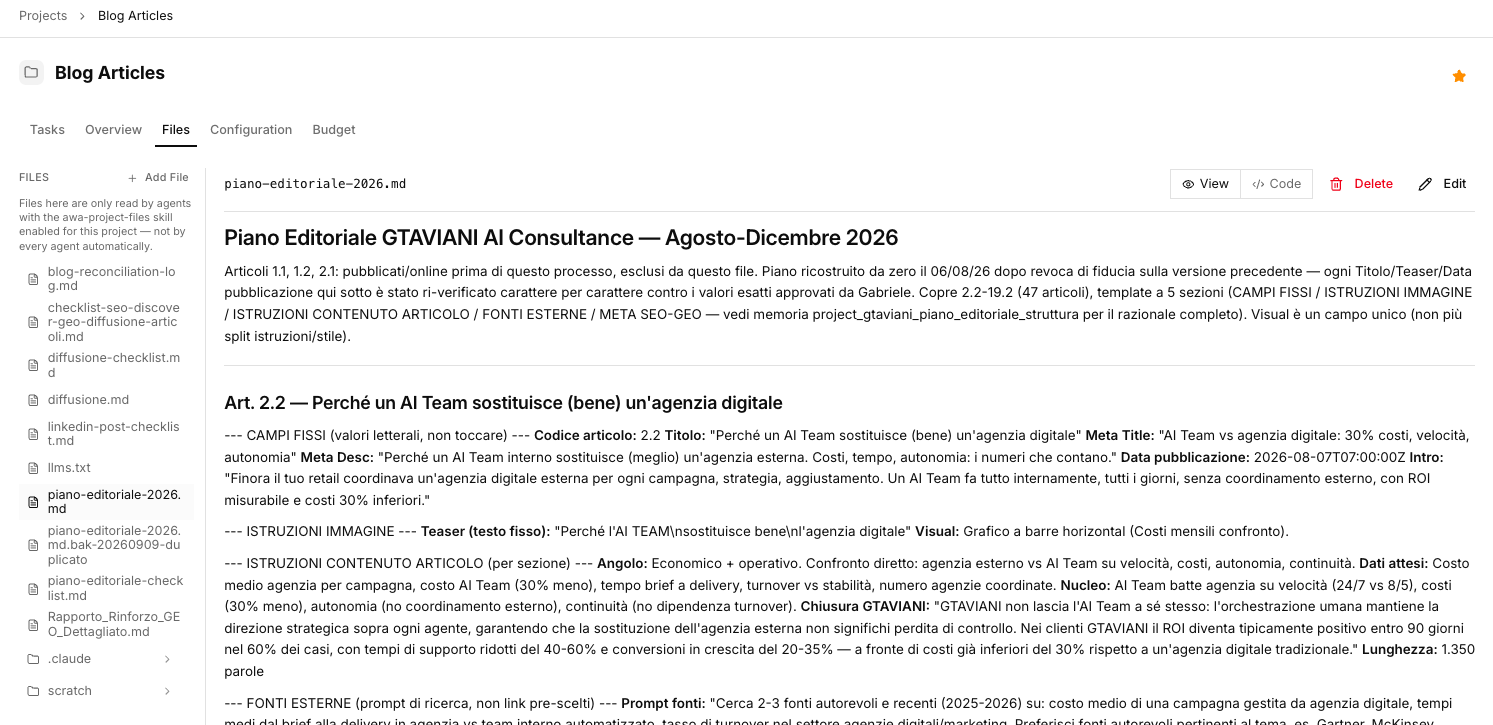
  • Files — a function added by AWA to share static and dynamic documents across every agent involved in the project
Projects in AWA AI Teams

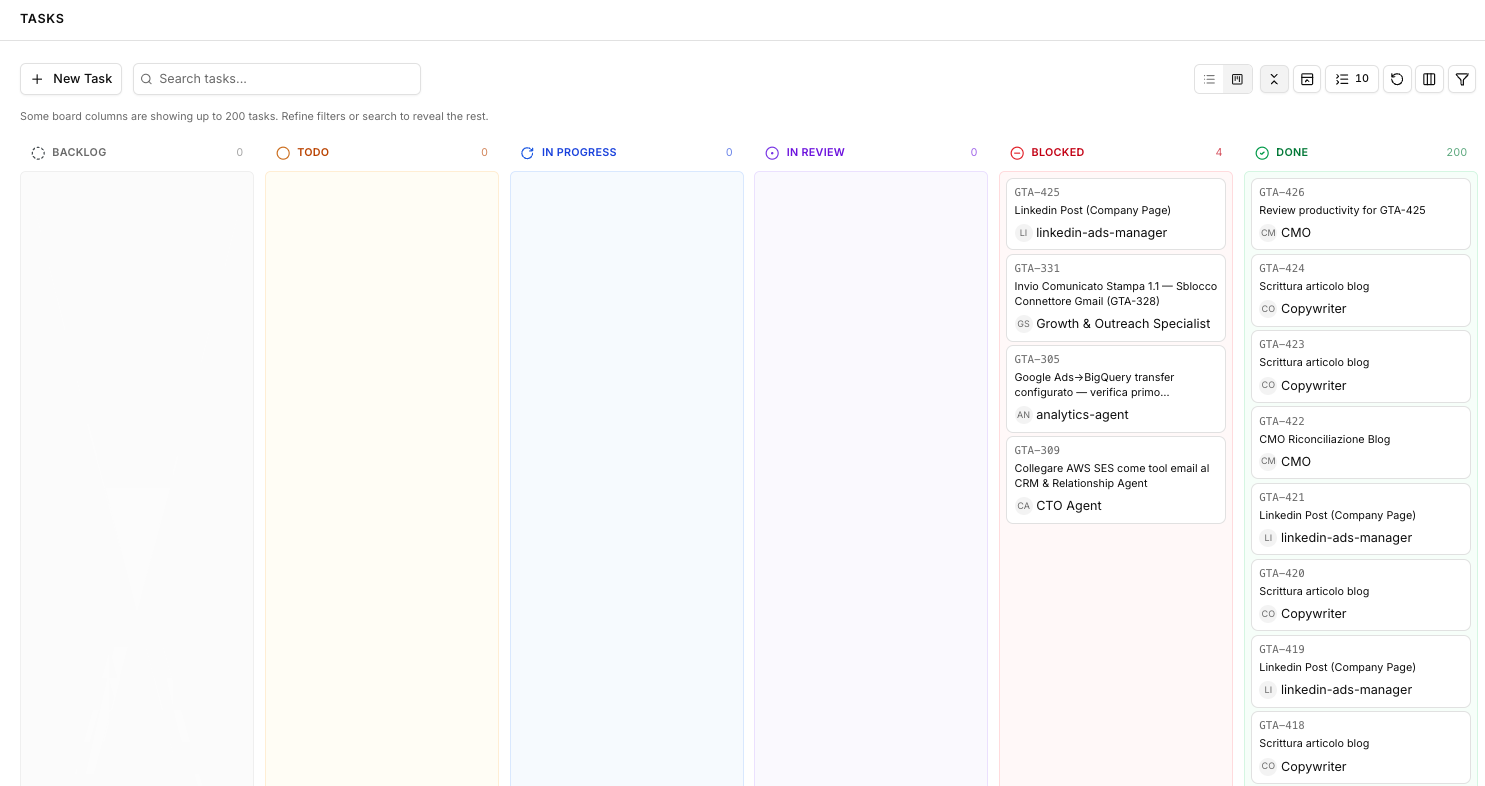
Tasks: every task, tracked like a real team's

Backlog, Todo, In Progress, In Review, Blocked, Done — agents move tickets through the same board a human team would use. Nothing gets marked finished without a trace: every card links back to the agent that owns it and the routine or request that created it. This is ai agent management a consultant can audit at a glance, not a black box.

AWA AI Teams task board
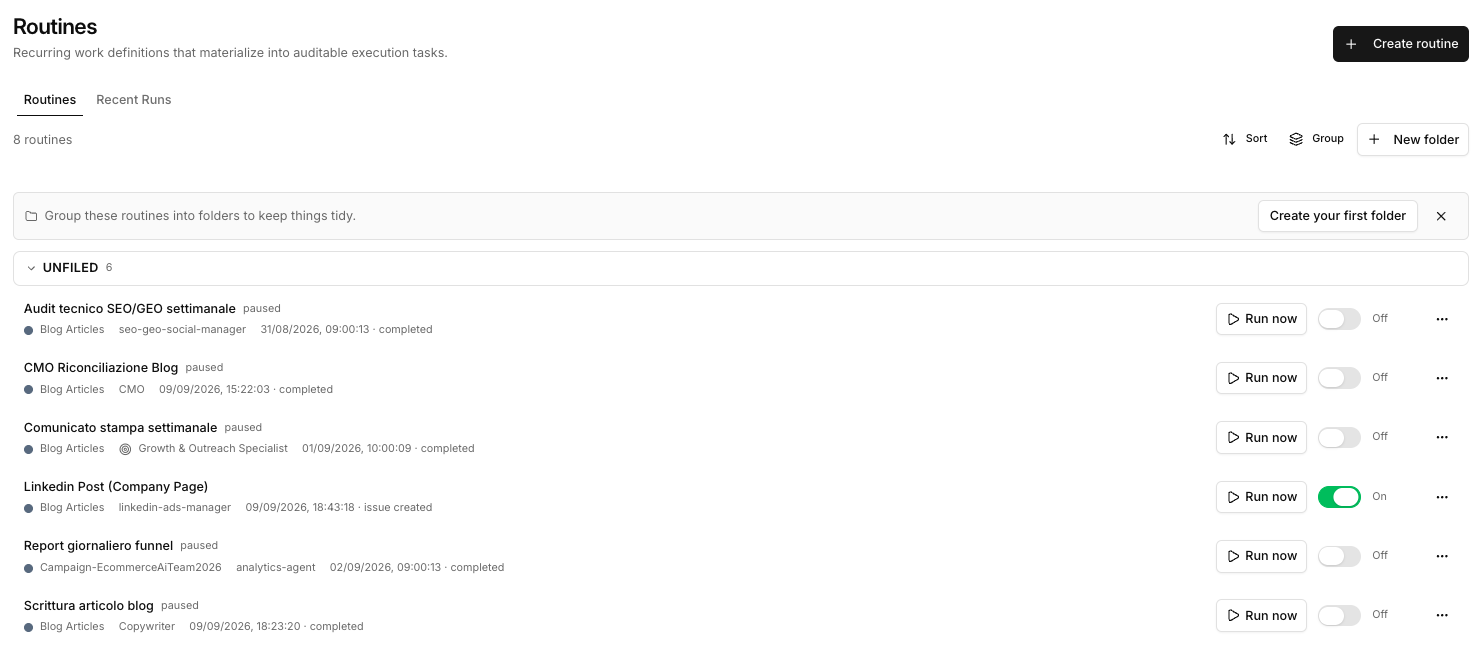
AWA AI Teams scheduled routines

Routines: recurring work runs itself, on schedule

Weekly SEO/GEO audits, daily funnel reports, scheduled blog drafts: routines are recurring work definitions that fire on their own heartbeat, with no human triggering each run. Turn one on, and the agent wakes up, checks its brief, and acts — the same ai agent heartbeat model that makes Paperclip AI agents run unattended, now configured per client inside AWA.

AI Agents: what gets configured for each one

Every agent on the team is configured from a dedicated panel, with the same functions for all of them:

  • Instructions — what the agent follows
  • Skills — the capabilities it has installed
  • Configuration — its assigned AI adapter
  • Integrated Tools — the systems it can reach
  • Runs — its execution history
  • Audit — a full log of every action
  • Budget — its individual spending cap

A true ai agent audit log, the same tracking discipline as Paperclip AI — the consultant sees what the team actually did, not just what it was supposed to do.

AI agent configuration panel
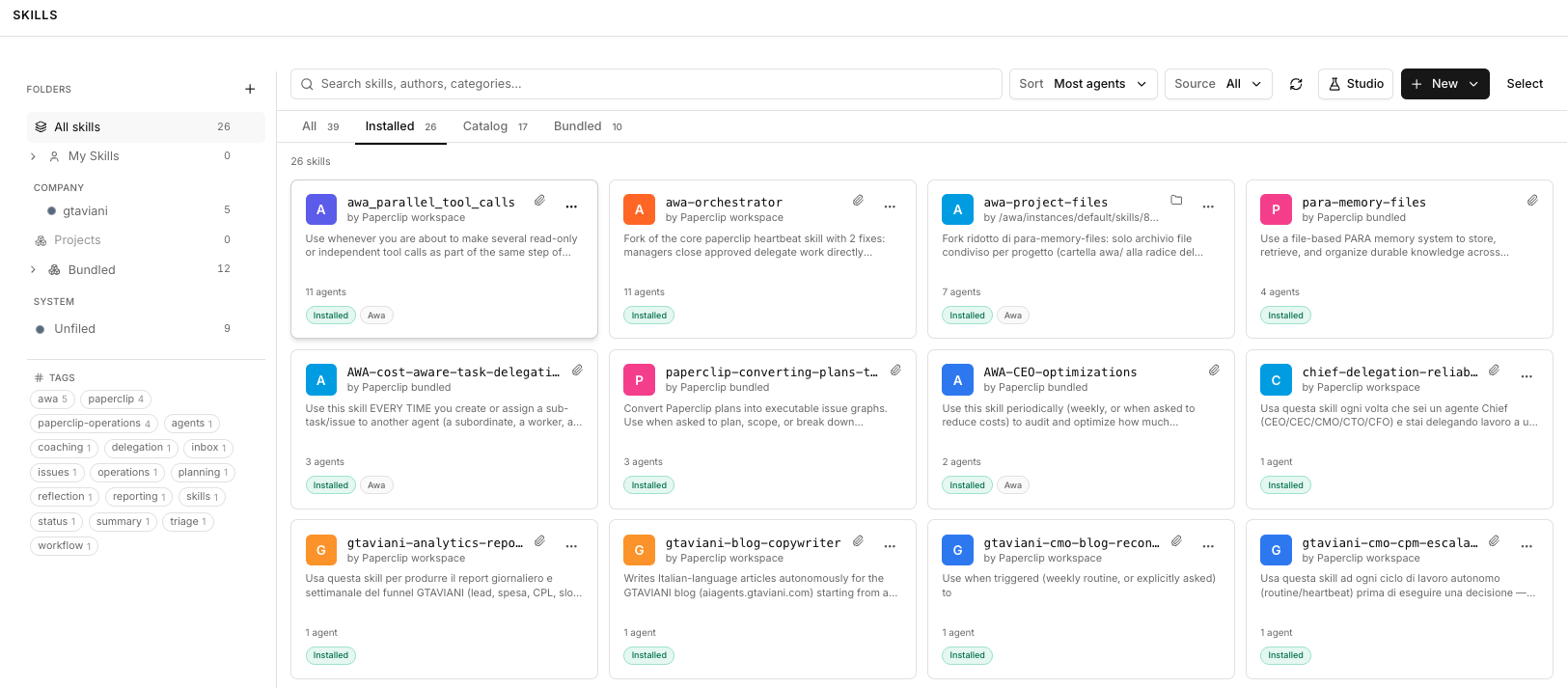
AWA AI Teams skills catalog

Skills: a skills catalog, curated not chaotic

Skills are the extensions that give an agent a specific capability — orchestration, parallel tool calls, project file access, client-specific playbooks. AWA AI Teams ships with a curated ai agent skills catalog: some bundled from Paperclip, some built by AWA, all reviewed before they reach a client's team. The consultant enables what's relevant, not just what's available.

AWA CAWP (exclusive)

Built into Plugins/Skills

AWA CAWP (Commitment-Aware Workflow Protocol) is AWA's proprietary method, built into the exclusive AI Team plugins and skills: a verifiable contract on the task to be done, agreed before the work starts — not a subjective evaluation after the fact.

  • Preparation — the agent defines the conditions for completion before starting
  • Negotiation — the conditions are agreed before execution
  • Performance — the work is carried out and the outcome verified
  • Acceptance — the result is validated against the agreed conditions, or the cycle repeats
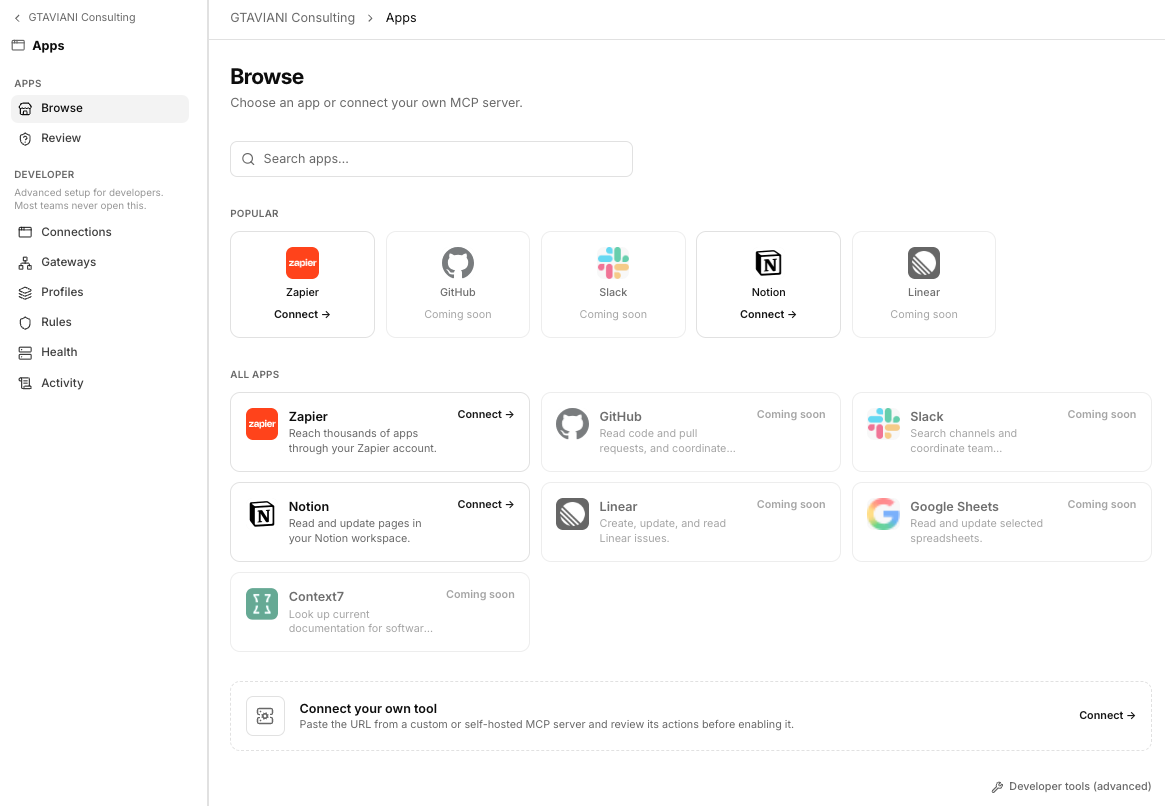
AWA AI Teams apps and tools marketplace

Apps & Tools: connect the tools your client already uses

Zapier, Slack, Notion, Linear, Google Sheets, GitHub — or any custom MCP server. The Apps marketplace is how agents reach the systems a business already runs on, reviewed and approved before an agent can act through them. It's the same model-agnostic, ai agent tools philosophy Paperclip AI popularized, wrapped here in AWA's governance layer.

Custom AI Tools

AWA Service

On behalf of AI consultants, AWA builds and integrates Apps/Tools for any company system or SaaS to connect, then makes them available to one or more of the consultant's clients.

Costs & Budgets
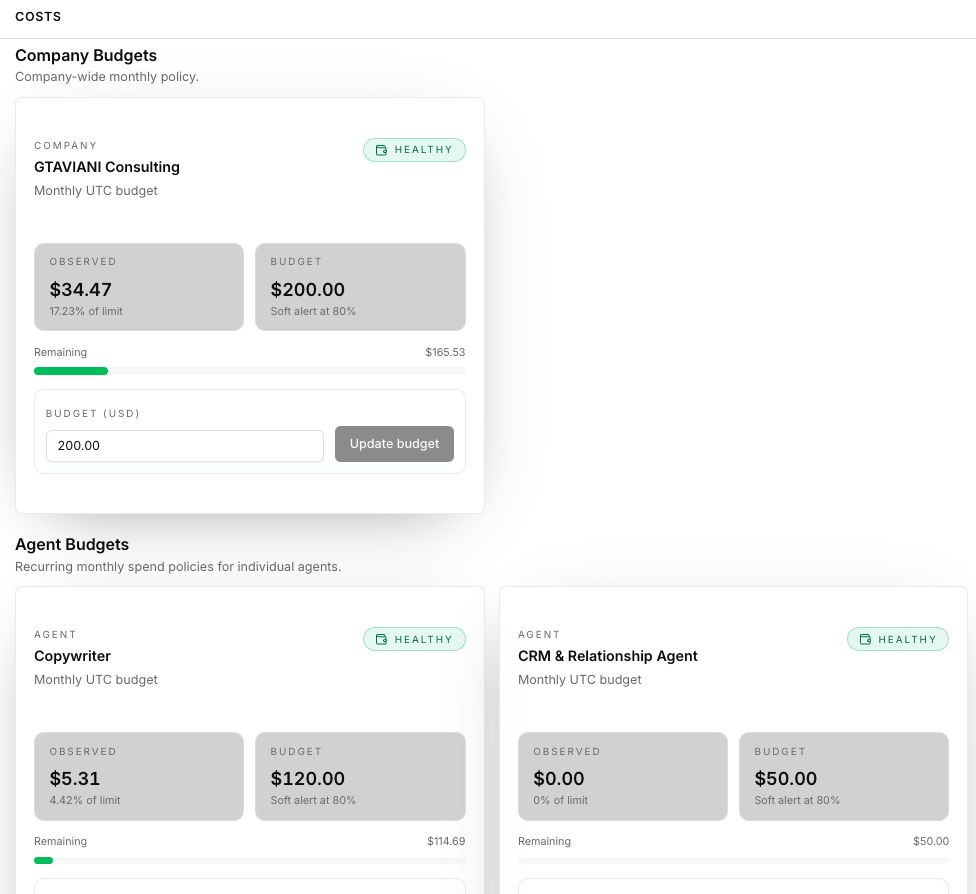
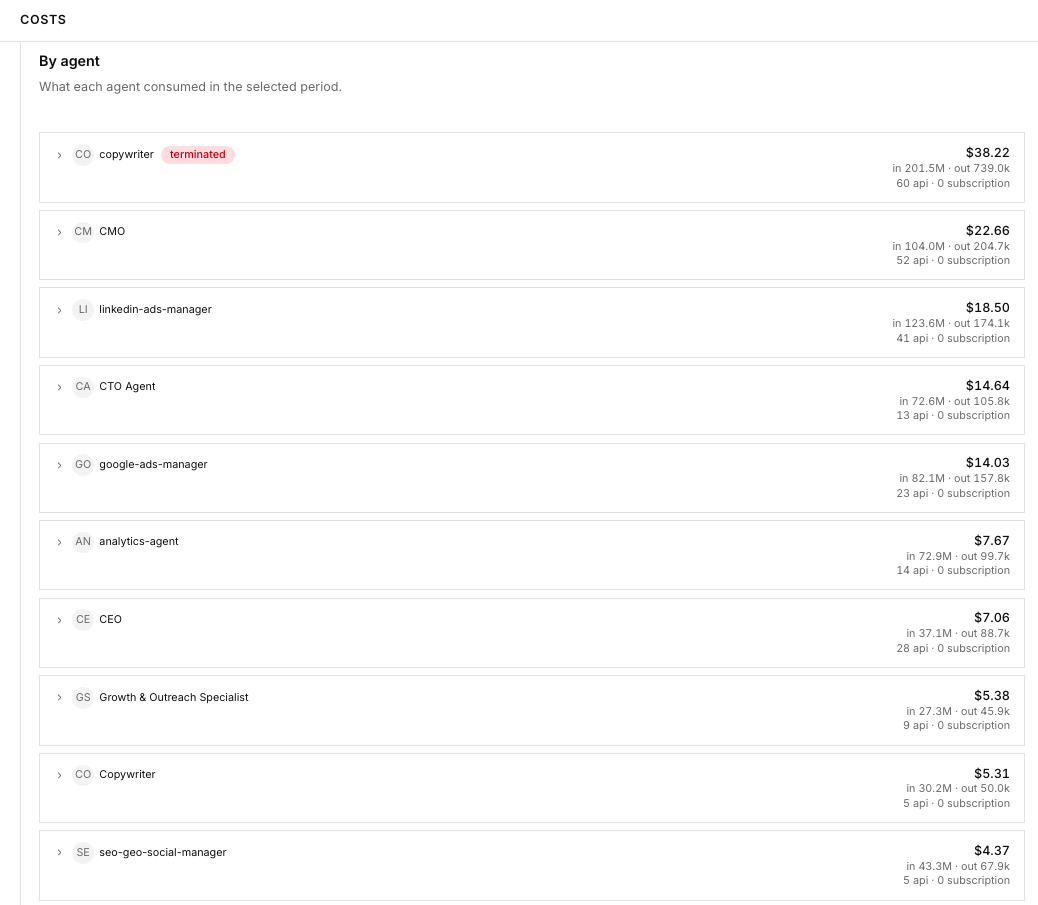
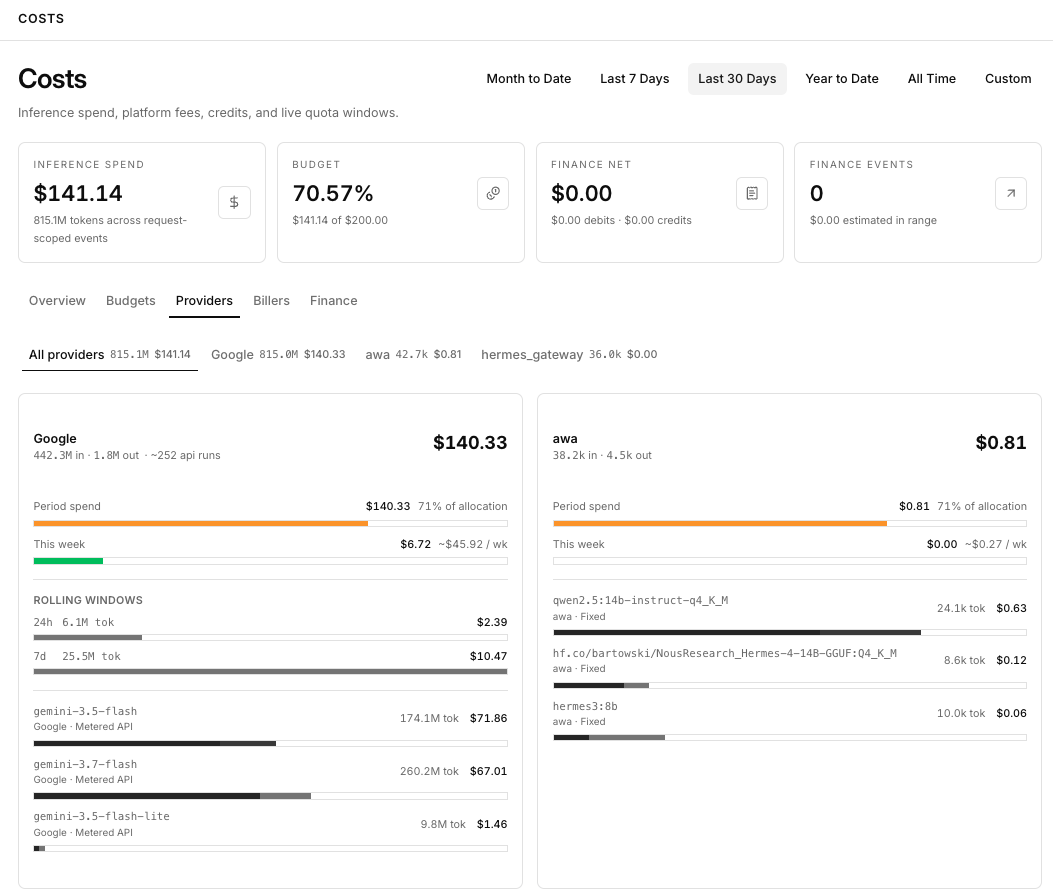
real agent budget control

Spend is tracked by provider, by model, by individual agent — not just as one invoice at the end of the month. Company-wide and per-agent budgets carry soft alerts and a hard stop: an agent that hits its cap pauses itself instead of running up a bill. It's ai agent cost tracking and agent budget control built into the platform, not bolted on with a spreadsheet.

AWA AI Teams company and agent budgets AWA AI Teams cost by agent AWA AI Teams cost by model
BETA Service

Request beta access

AWA AI Teams is currently activated only for consultants enabled by AWA. Sign up as an agency/consultant and request access.

A scalable rollout, not an instant switch-on

Bringing an AI Team up to speed for an SME typically takes 45-60 days and preliminary analysis work: an AI Team Brief and an AI Team Project (org chart, resources, and for each one a Condition of Satisfaction, instructions and skills).

An AI Team integrates into the client's organization and works alongside people: it should be rolled out gradually, often after a first test with Relevance AI, not switched on and left alone.

Frequently Asked Questions

Why choose AWA AI Teams instead of using Paperclip AI OS directly?

On your own, every client is a configuration from zero, you need technical skill to not get it wrong, AI consumption stays an opaque cost, you're selling the consultant's time, and updates/security are on you. With AWA AI Teams, every client is born from a curated model improved over time, the delicate choices are already made and tested, consumption is measured per client with a cap and reporting, you're selling a service that works even when the consultant isn't there, and the platform is maintained, updated and monitored by AWA.

Who is AWA AI Teams for?

For the AI consultant serving small and medium businesses who wants to stop selling hours. For agencies who want to offer their clients an operating team without building a technical department.

What is AWA AI Teams / Paperclip AI?

AWA AI Teams / Paperclip AI is the platform that lets AI Consultants and Agencies build a dedicated AI Agent team for each client, directly inside AWA. It's a heavily customized adaptation of Paperclip AI, an open-source AI agent orchestration platform: agents get real roles, a reporting hierarchy, a budget and a full execution history, instead of running as isolated, unstructured prompts.

What is AWA AI Teams / Paperclip AI for?

It replaces the manual, from-scratch setup a consultant would otherwise build for every client — which models to use, which tools to connect, who can access what, how much can be spent — with a ready-made, governed environment. The consultant's job becomes setting goals and reviewing results, not assembling infrastructure client by client.

What does "zero-human company" mean?

"Zero-human company" is the long-term vision behind Paperclip AI's open-source architecture: a business where AI agents, not people, run day-to-day operations end to end. It's a description of the underlying software's ambition, not a claim about how AWA AI Teams is actually delivered today — see the next question.

Can AWA AI Teams / Paperclip AI really run a business without people?

No — not in the way AWA delivers it. Every AI Team runs under a human owner and defined user roles (owner, admin, operator, viewer), with a spending cap that pauses the team automatically and a full audit log of everything each agent did. The consultant or agency stays in charge at every step; no team is left to operate unsupervised.

What's the difference between AWA AI Teams / Paperclip AI and n8n, Zapier or Make?

n8n, Zapier and Make connect apps and automate individual workflows — trigger, action, done. AWA AI Teams / Paperclip AI orchestrates a whole team of AI agents with roles, a reporting hierarchy, a shared budget and an audit trail: it's built to run ongoing work across a business, not to fire a single automated workflow.

What's the difference between AWA AI Teams / Paperclip AI and ChatGPT or Claude?

ChatGPT and Claude are conversational assistants you talk to directly, one exchange at a time. AWA AI Teams / Paperclip AI is the layer that organizes multiple AI agents — which can themselves be powered by models like Claude — into a structured team with goals, ownership and accountability, so work keeps moving without the consultant driving every single step.

What business activities can AWA AI Teams / Paperclip AI agents handle?

In practice, agents are configured around real functional roles — marketing (SEO/GEO, ads, social, copywriting), analytics and reporting, CRM and relationship management, and similar operational functions — each with its own instructions, tools and budget. Which activities a given team covers depends entirely on how the consultant designs the org chart for that client.

Do I need technical skills to use AWA AI Teams / Paperclip AI?

No. Model choice, integrations and the core skill set are pre-configured and tested by AWA. The consultant works through the AWA interface — creating the team, assigning access, setting goals — without touching code or infrastructure.

Is human supervision still required?

Yes, always. AI agents propose and execute work inside the boundaries set by the consultant: budgets, roles and an audit log exist specifically so a human stays in control of what the team does and how much it costs. AWA AI Teams is built to be supervised, not left unattended.

Is AWA AI Teams / Paperclip AI suitable for an SME?

Yes — that's the intended use case. It's designed for small and medium businesses served by an AI consultant or agency, not for enterprises building their own AI infrastructure in-house. Rolling out an AI Team for an SME typically takes 45-60 days of guided setup, not an instant switch-on.

What are the limits of AWA AI Teams / Paperclip AI?

It requires proper upfront design — an AI Team Brief and Project with a real org chart and Conditions of Satisfaction — not a five-minute setup. Agents need supervision and clear goals to be effective; results depend on the quality of that setup, not just on activating the platform. And each agent activation has a real token cost, so the economics matter for how a team is structured.

What is the CEO agent?

In an AWA AI Team's org chart, the CEO agent sits at the top, with director-level agents (like a CMO or CTO) reporting to it and operational sub-agents beneath them. It's the coordination point of the hierarchy the consultant designs — not an autonomous decision-maker acting without oversight.

Can I approve actions before they're executed?

Governance in AWA AI Teams is built around roles and limits rather than a manual approve-every-action queue: owners and admins control what each agent is allowed to do and spend, budgets pause a team automatically at the threshold, and every run is logged for review. The consultant sets the boundaries; the audit log shows exactly what happened inside them.

Is AWA AI Teams / Paperclip AI useful for an e-commerce business?

Yes — an AI Team can be built around e-commerce-relevant roles such as ads management, SEO/GEO, analytics and reporting, or customer relationship management, each with its own tools and budget. As with any client, the setup is designed by the consultant for that specific business, not generic out of the box.

What concrete results can I expect?

Since AWA AI Teams is still in BETA and early stage, there isn't yet a published case study with numbers to point to. What changes operationally is measurable from day one, though: work that used to require the consultant's direct time runs inside a governed team instead, every euro of AI spend is tracked per client with a cap, and every action is logged — so scale and accountability grow together, without waiting on a specific ROI claim.